

What is Ambisonics | What is Higher-Order Ambisonics (HOA) | How Far Can Higher-Order Ambisonics Go? | Can We Actually Measure Ambisonics Spatial Resolution? | Why Does Higher-Order Ambisonics Usually Stop at 7OA? | Which Ambisonics Order Should I Use? | What Are AmbiX, FuMa, ACN and Ambisonics Normalisation?
What is Ambisonics?
To understand Ambisonics, we first need to understand a little about how stereo works.
And surprisingly, the easiest way to understand Ambisonics is through a recording technique that's been around for almost a century: Mid-Side stereo.
But first, a little history.
Who invented Ambisonics, and why?
Ambisonics was developed in Britain during the early 1970s, principally through the work of Michael Gerzon, associated with the University of Oxford, and Professor Peter Fellgett, of the University of Reading, alongside other researchers and engineers.
At the time, the recording industry was experimenting with quadraphonic sound: systems that attempted to reproduce audio around the listener using four loudspeakers.
The problem was that these systems generally relied on particular loudspeaker arrangements. Different formats competed for adoption, and recording music for one system didn't necessarily translate well to another.
Gerzon and his colleagues explored a different approach.
What if, instead of recording sound for particular loudspeakers, we recorded information about the soundfield itself?
That question helped shape Ambisonics.
And to understand why this was revolutionary, let's begin with stereo.
0. How does traditional stereo work?
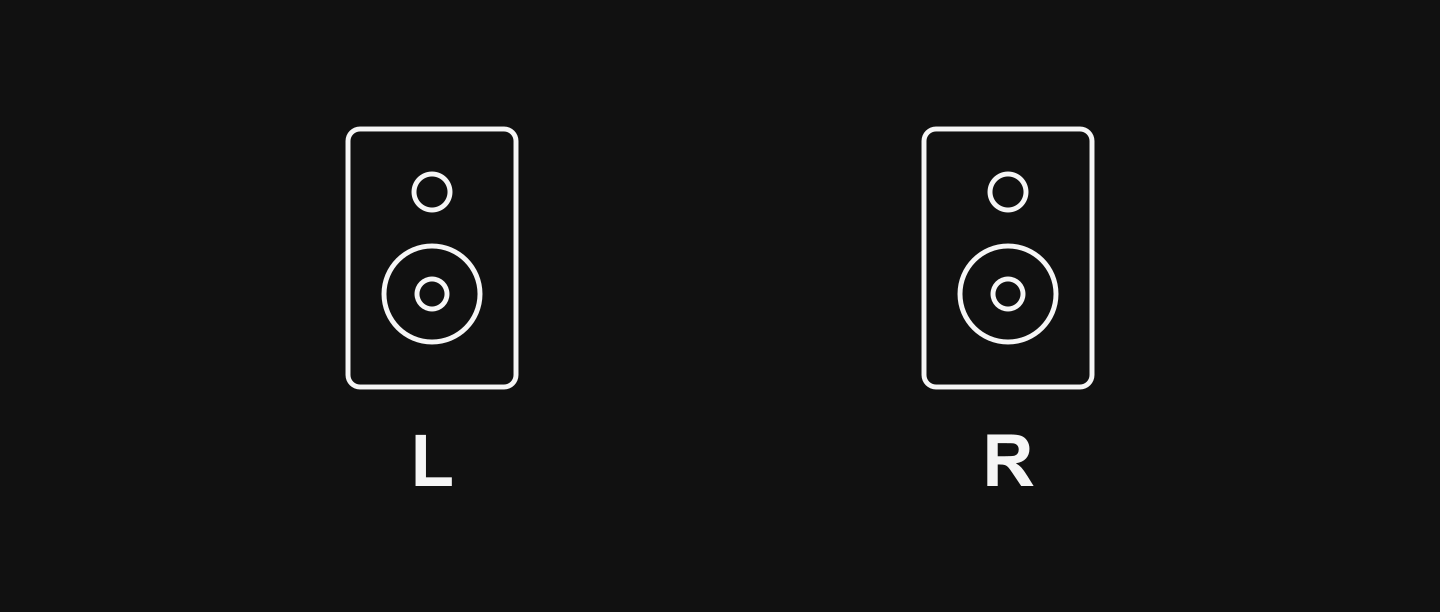
In conventional stereo, we work with two audio channels: Left (L) and Right (R).
These channels carry the signals intended for two loudspeakers, allowing us to create the impression that sounds originate from different positions between them.
For example, when recording an orchestra, the violins might appear towards the left, the cellos towards the right, and the conductor's position near the centre.
This works remarkably well, but the recording is organised around two playback channels.
If we want to reproduce sound from additional directions, conventional channel-based systems introduce more channels and loudspeakers — such as 5.1 or 7.1 surround.
But what if we could represent stereo differently, without storing separate left and right signals?
That's where Mid-Side comes in.
1. How does Mid-Side stereo work?
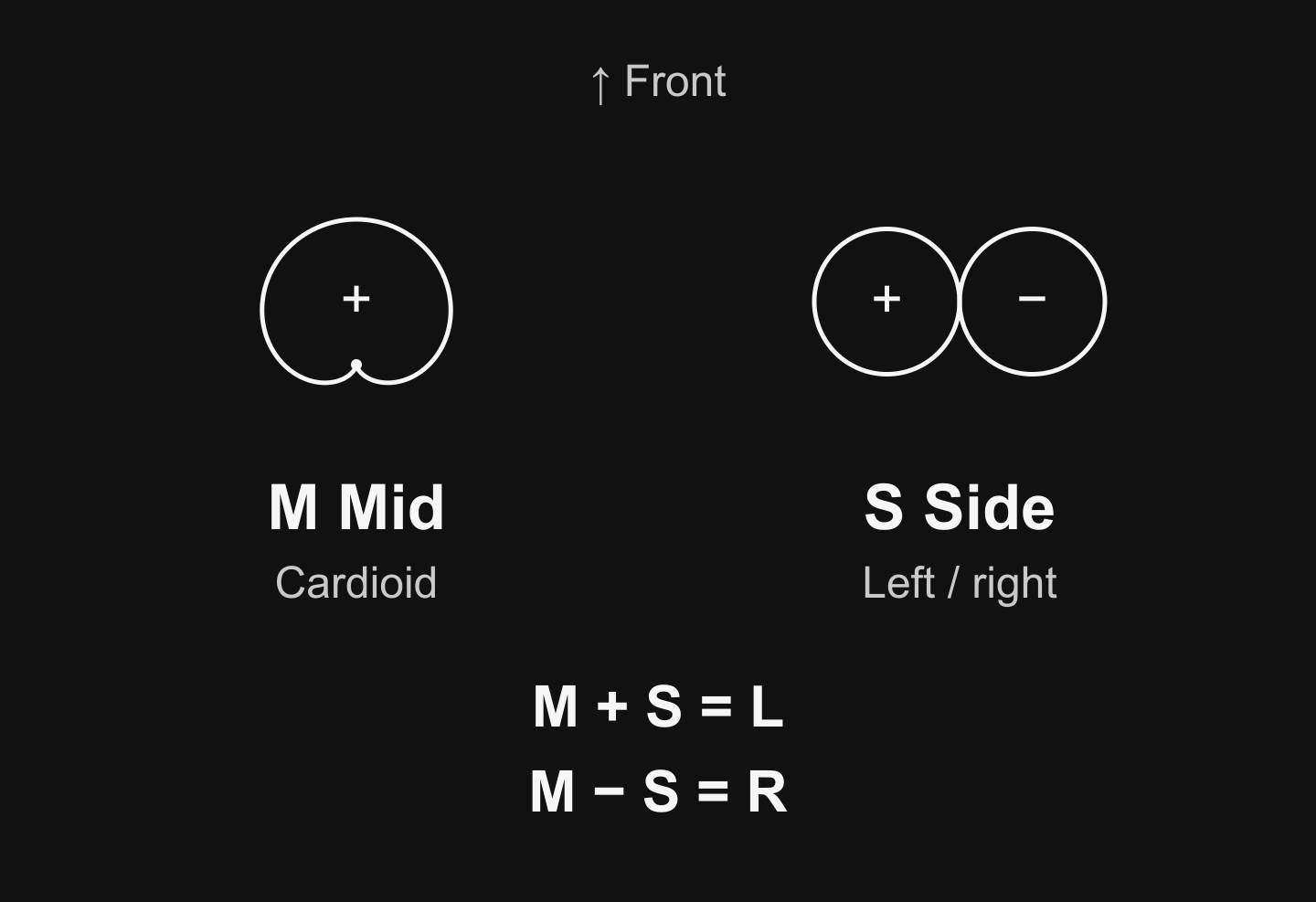
Mid-Side (MS) stereo approaches the same stereo information from a different perspective.
Rather than storing the left and right channels directly, it uses two components:
Mid (M): The information common to the left and right channels, often captured using a forward-facing microphone.
Side (S): The difference between left and right, typically captured using a sideways-facing figure-of-eight microphone.
Using these components, we can reconstruct conventional stereo:
Left = Mid + Side
Right = Mid − Side
The interesting part is that Mid-Side doesn't require us to think exclusively in terms of left and right loudspeaker signals.
Instead, we can work with a central component and a directional difference component, combining them later to create our stereo output.
We can even adjust the apparent width of the stereo image simply by changing the level of the Side signal.
And this brings us to Ambisonics.
2. How does first-order Ambisonics work?
Imagine taking the Mid-Side concept and expanding it beyond left and right.
What if, instead of measuring only the difference between the two sides, we could represent directional information along three axes?
Left and right
Front and back
Up and down
That's the basic idea behind First-Order Ambisonics (1OA, or sometimes referred to as FOA).
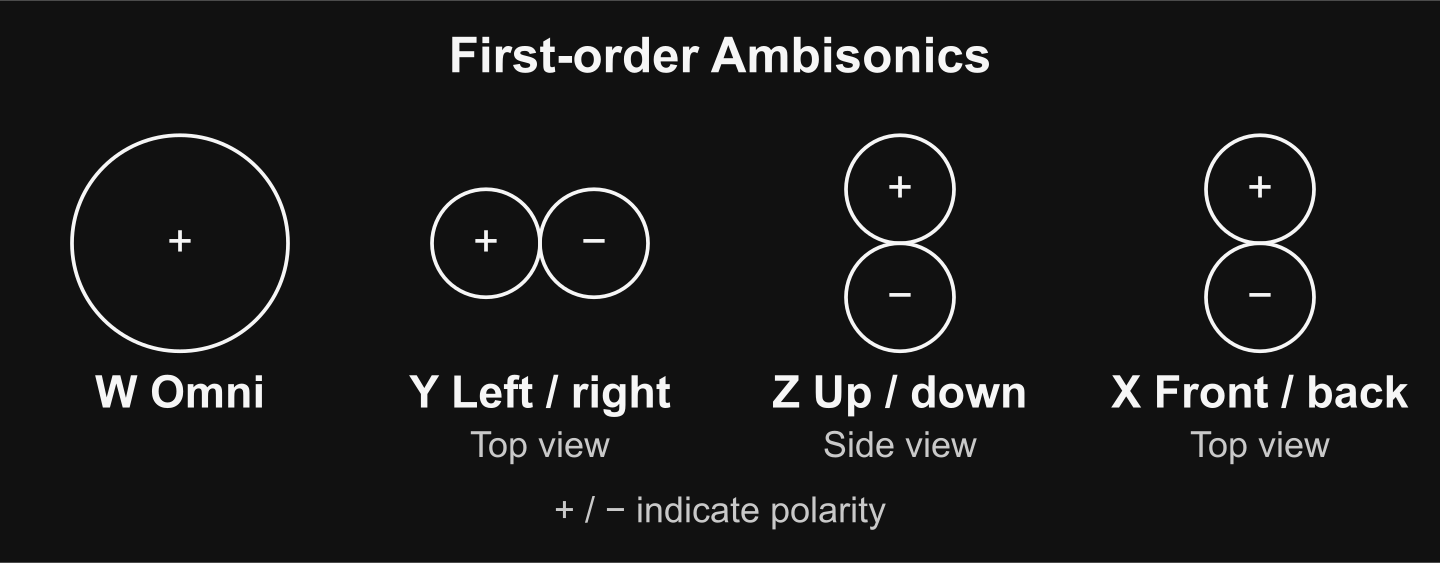
Instead of two channels, we now have four soundfield components:
W: An omnidirectional component, representing sound pressure without favouring a particular direction.
X: A directional component describing front-to-back differences.
Y: A directional component describing left-to-right differences.
Z: A directional component describing up-to-down differences.
Together, these form a first-order Ambisonics representation commonly known as B-format.
Notice something important: these four channels are not four loudspeaker feeds.
They describe different components of the same three-dimensional soundfield.
We can then combine these components to derive signals for different listening directions, rotate the soundfield, or decode it for headphones and compatible loudspeaker arrangements.
And because the soundfield isn't tied to a particular playback layout, we can decide how to reproduce it later.
…Do you see it?
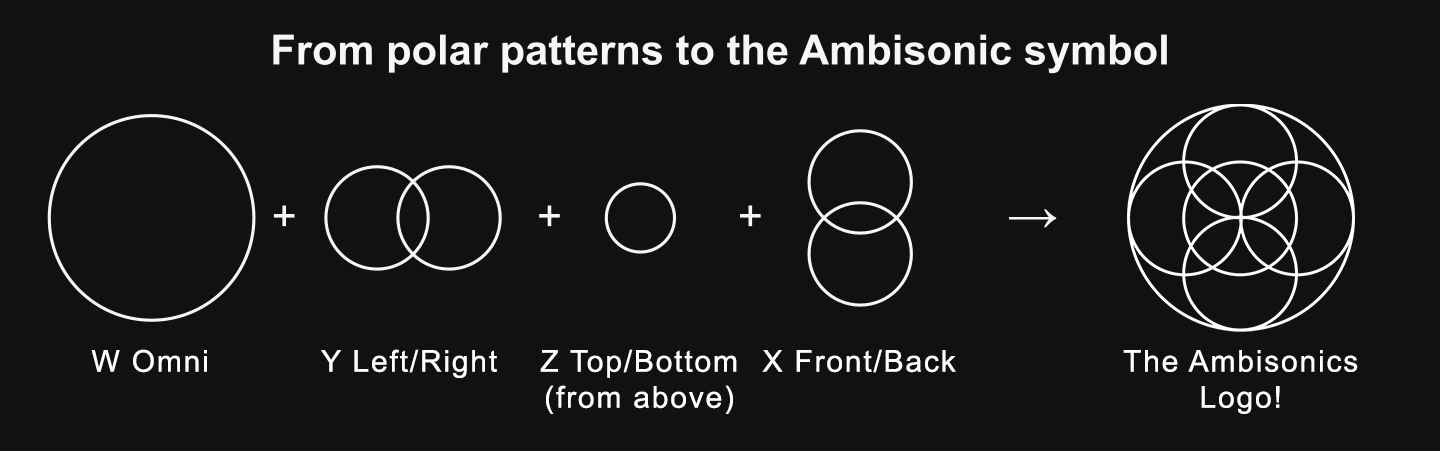
3. So, Ambisonics is Mid-Side on steroids!
In a way, yes!
Mid-Side stereo represents a stereo signal using a central component and a sideways directional difference.
First-order Ambisonics builds on a closely related idea, adding directional components for the other axes to describe sound arriving from all around the listener.
Of course, the underlying theory is more sophisticated, but the analogy is a useful way to understand the concept.
Stereo gives us Left and Right.
Mid-Side gives us Mid and Side.
First-Order Ambisonics gives us W (everything), Y (side), Z (top/bottom) and x (front/back) — a representation of the soundfield in three dimensions.
And we're only getting started.
By introducing additional components through Higher-Order Ambisonics (HOA), we can describe the soundfield with progressively greater spatial resolution.
But how can adding more channels make a soundfield more precise?
That's where spherical harmonics come into play.
What is Higher-Order Ambisonics (HOA)?
You've already learnt how First-Order Ambisonics works using four components: W, Y, Z and X.
But there's something we haven't mentioned yet.
Despite its name, First-Order Ambisonics actually contains two orders: the zeroth order (0OA) and the first order (1OA).
Let's rewind for a moment and see what that means.
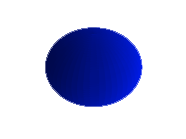
Let's start with the zeroth order: W.
Imagine an omnidirectional microphone capturing sound from every direction.
Blue is +
If we represent its polar pattern visually, we get a circle — or, in three dimensions, a sphere.
Every direction has the same sensitivity and the same positive polarity.
This is our W component.
It captures sound without distinguishing where that sound comes from. In other words, it has zero directional resolution.
Now, imagine we wanted to introduce directional information.
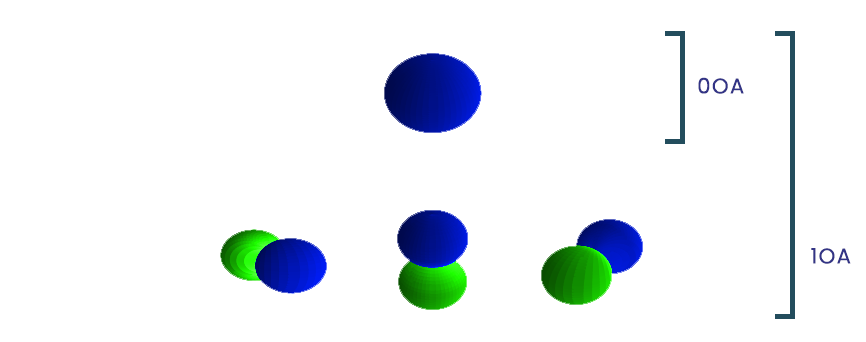
What if we divided our sphere into two halves, with one side positive and the other negative polarity?
How many independent ways could we do that to describe all three dimensions?
Three!
Left versus right — Y
Up versus down — Z
Front versus back — X
Each division introduces a figure-of-eight directional pattern, with positive sensitivity on one side and negative sensitivity on the other.
And here's the interesting part.
Our original omnidirectional W component, together with these three directional components — X, Y and Z — forms First-Order Ambisonics!
Blue is +, Green is -
We've gone from a single omnidirectional component with no directional discrimination to a four-component representation containing directional information along all three spatial axes.
But did you notice something interesting?
When we built our First-Order Ambisonics signal, we didn't replace the original omnidirectional W component. We kept it and added three new directional components: Y, Z, and X
This means that 1OA already contains both the zeroth-order and first-order components!
0th order: W — 1 channel
1st order: Y, Z and X — 3 additional channels
Total: 4 channels.
And here's something important to remember: each new Ambisonics order includes all the previous orders.
As we'll discover shortly, that's exactly how Higher-Order Ambisonics works!
But before we continue with Higher-Order Ambisonics…
Meet the Spherical Harmonics!
Those shapes we've just explored — the omnidirectional sphere and the three figure-of-eight patterns — have a name: Spherical Harmonics.
But what exactly are they?
Think of spherical harmonics as a collection of mathematical patterns that describe how something varies across the surface of a sphere.
Each pattern divides the sphere into different regions, with positive and negative values. Some patterns are simple, while others become increasingly complex.
For example:
W is the simplest spherical harmonic: it has the same value in every direction.
Y, Z and X are the next three spherical harmonics: each has a positive and negative side, describing variation along a different axis.
And here's the interesting part: we can combine these patterns to describe much more complex directional information!
In Ambisonics, each spherical harmonic has its own audio channel, telling us how much of that pattern is present in the soundfield at any given moment.
So, rather than describing sound through individual loudspeakers, Ambisonics describes it through a combination of spherical harmonics.
And that's the secret behind Higher-Order Ambisonics: each new order introduces more spherical harmonics, allowing us to represent finer spatial details.
So… What is Higher-Order Ambisonics (HOA)?
Now that we understand First-Order Ambisonics, let's take things a little further!
We've already discovered that 1OA contains two orders: the zeroth order (W) and the first order (Y, Z, X), giving us four channels in total.
But what if we wanted to describe the soundfield in even greater detail?
That's where Higher-Order Ambisonics (HOA) comes in!
Higher-Order Ambisonics introduces new, increasingly complex spherical harmonic patterns, creating finer directional variations across the sphere and allowing us to represent the soundfield with greater spatial resolution.
Remember those simple shapes we explored earlier? As we move to higher orders, the new spherical harmonics develop additional positive and negative regions. Some have narrower lobes, while others introduce more intricate patterns across the horizontal and vertical dimensions.
Let's see how this progresses:
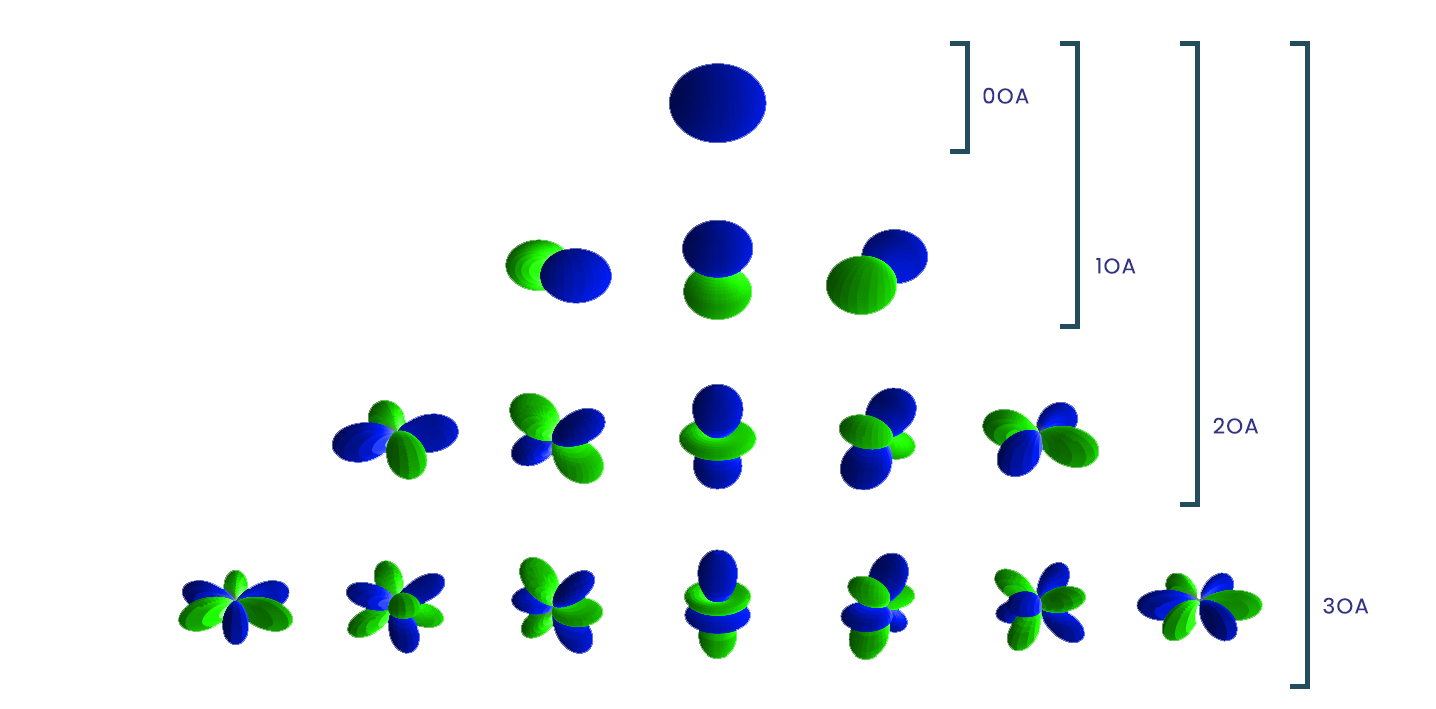
0OA: One omnidirectional spherical harmonic (W). It captures sound without distinguishing its direction. 1 channel.
1OA: Three additional spherical harmonics (Y, Z, X), each with two opposing lobes. Together with W, they describe directional differences along three axes. 4 channels in total.
2OA: Five new spherical harmonics, introducing more complex patterns with additional positive and negative regions. These allow us to describe spatial variations that 1OA cannot represent. 9 channels in total.
3OA (also referred to as TOA): Seven new spherical harmonics, with even more intricate directional patterns and finer spatial variations. 16 channels in total.
Blue is +, Green is -
Notice what's happening?
Each new order introduces more spherical harmonics, and these new patterns can describe increasingly fine details across the sphere.
The new harmonics don't replace or literally subdivide the previous ones. Instead, they add new ways of representing the soundfield.
And importantly, each higher Ambisonics order retains all the harmonics from the previous orders.
So 2OA contains everything from 1OA, plus five new harmonics. And 3OA contains everything from 2OA, plus another seven.
That's the principle behind HOA: more spherical harmonics, more complex patterns, and greater spatial resolution.
How Far Can Higher-Order Ambisonics Go?
We've seen how each new Ambisonics order introduces additional spherical harmonics, allowing us to describe increasingly fine spatial variations.
But the progression doesn't stop at 3OA!
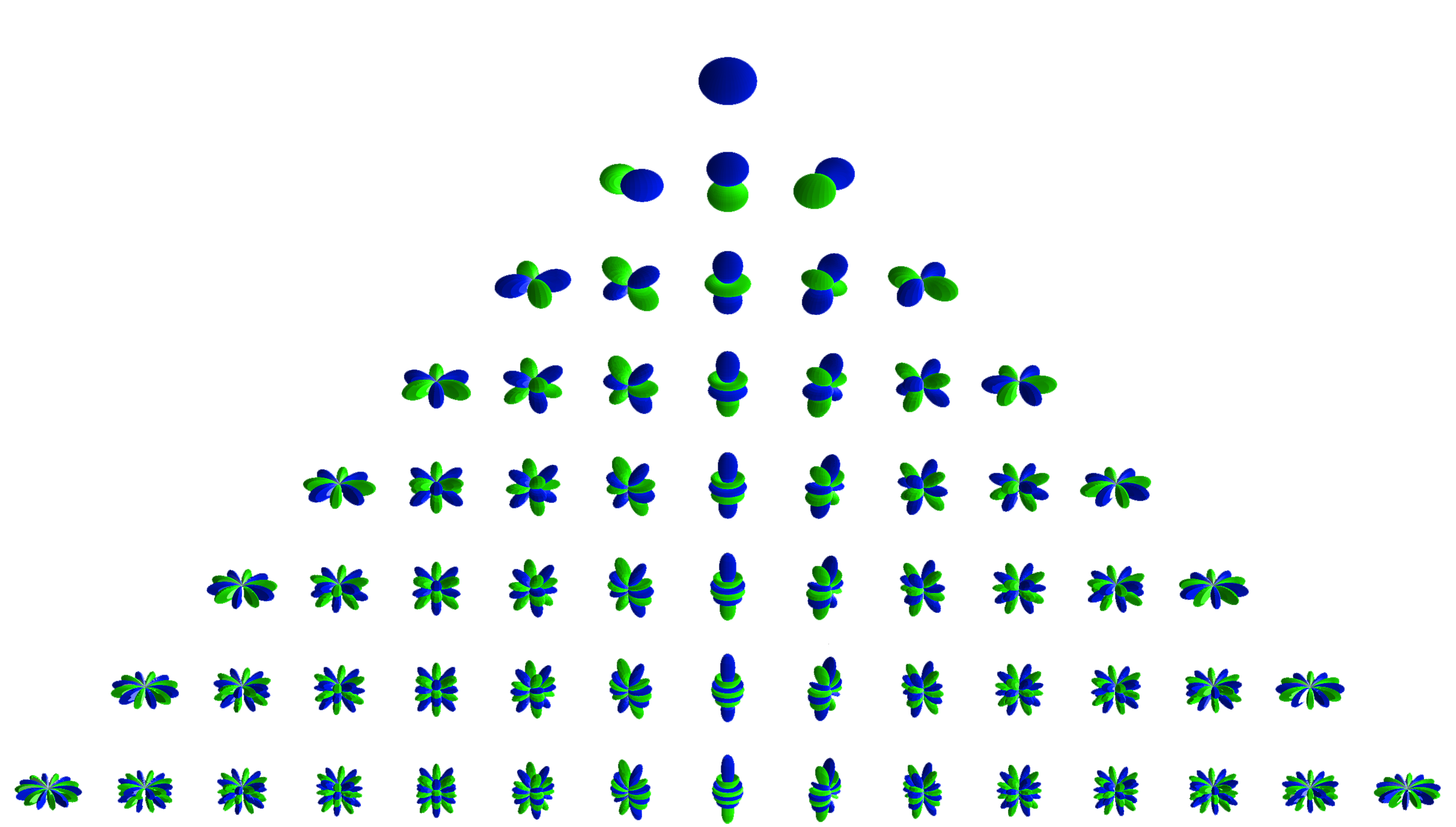
As we continue towards higher orders, the new spherical harmonics exhibit even more intricate patterns, with additional positive and negative regions and, in many cases, narrower directional lobes.
Let's continue where we left off:
4OA: Adds 9 new spherical harmonics, bringing us to 25 channels in total.
5OA: Adds 11 new spherical harmonics, bringing us to 36 channels.
6OA: Adds 13 new spherical harmonics, bringing us to 49 channels.
7OA: Adds 15 new spherical harmonics, bringing us to 64 channels!
Blue is +, Green is -
Thanks to the late Angelo Farina for this amazing graphic
Notice the pattern?
Every new order introduces two more spherical harmonics than the previous order, while retaining all the harmonics from lower orders.
And here's something interesting: the number of audio channels required for full three-dimensional Ambisonics follows a remarkably simple formula:
Channels = (Order + 1)²
For example:
1OA: (1 + 1)² = 4 channels
3OA: (3 + 1)² = 16 channels
5OA: (5 + 1)² = 36 channels
7OA: (7 + 1)² = 64 channels
Does a Higher Order Always Mean Better Audio?
Not necessarily!
Higher-Order Ambisonics doesn't inherently improve the frequency response, dynamic range or recording quality of an audio signal.
What it improves is the spatial resolution of the soundfield representation.
Higher orders can provide greater directional precision, making it possible to analyse, manipulate and reproduce sound with finer spatial detail.
However, the actual results also depend on the recording, processing algorithms, decoder and playback system.
The key takeaway?
Higher-Order Ambisonics allows us to describe the same three-dimensional soundfield with progressively greater spatial detail, simply by introducing additional spherical harmonics.
Can We Actually Measure Ambisonics Spatial Resolution?
We've seen how Higher-Order Ambisonics introduces increasingly complex spherical harmonics, allowing us to describe finer spatial details.
But how much finer do these patterns actually become?
One way to illustrate this is by looking at their angular width.
Remember those positive and negative lobes we saw in our spherical harmonic diagrams?
For certain spherical harmonics, these lobes become progressively narrower as the order increases.
We can express their approximate angular half-width as:
Angle = 90° ÷ Order
This gives us:
1OA = ~90°
2OA = ~45°
3OA = ~30°
4OA = ~22.5°
5OA = ~18°
6OA = ~15°
7OA = ~12.86°
Notice how the angle decreases with every new order?
This is one way to visualise how higher-order spherical harmonics can represent increasingly fine directional variations.
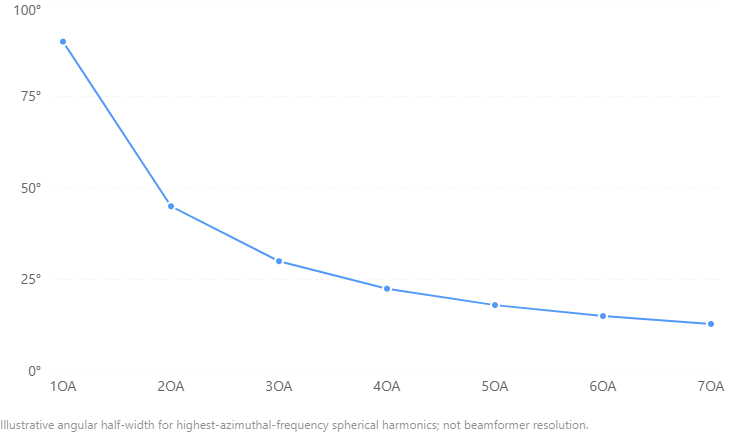
But there's an important distinction!
These angles describe the half-width of lobes in a particular family of spherical harmonics. They don't represent the exact spatial resolution of an Ambisonics recording, or the width of a directional beam.
When we combine spherical harmonics using techniques such as beamforming, the resulting directional precision depends on the algorithm, the Ambisonics order and how those harmonics are weighted.
So while higher orders give us more detailed spatial information, how we combine and process that information is equally important!
Why Does Higher-Order Ambisonics Usually Stop at 7OA?
We've seen how increasing the Ambisonics order allows us to describe the soundfield with progressively greater spatial detail.
But here's an interesting question: why do so many practical Ambisonics workflows stop at Seventh-Order Ambisonics (7OA)?
The answer comes down to two words: diminishing returns!
Technically, Ambisonics doesn't stop at 7OA. We could continue to 8OA, 9OA, 10OA or even higher orders.
However, there's a trade-off.
As we increase the order, we introduce more spherical harmonics, allowing us to represent finer directional variations. But the number of required audio channels also increases dramatically.
Remember our formula?
Channels = (Order + 1)²
Now compare the numbers:
Ambisonics OrderTotal ChannelsApprox. Angular Half-Width
5OA → 36ch → ~18°
6OA → 49ch → ~15°
7OA → 64ch → ~12.86°
8OA → 81ch → ~11.25°
9OA → 100ch → ~10°
10OA → 121ch → ~9°
Notice something?
Going from 7OA to 10OA nearly doubles the number of audio channels, from 64 to 121.
Yet the approximate angular half-width of the selected spherical harmonic lobes decreases by only 3.86°, from ~12.86° to ~9°.
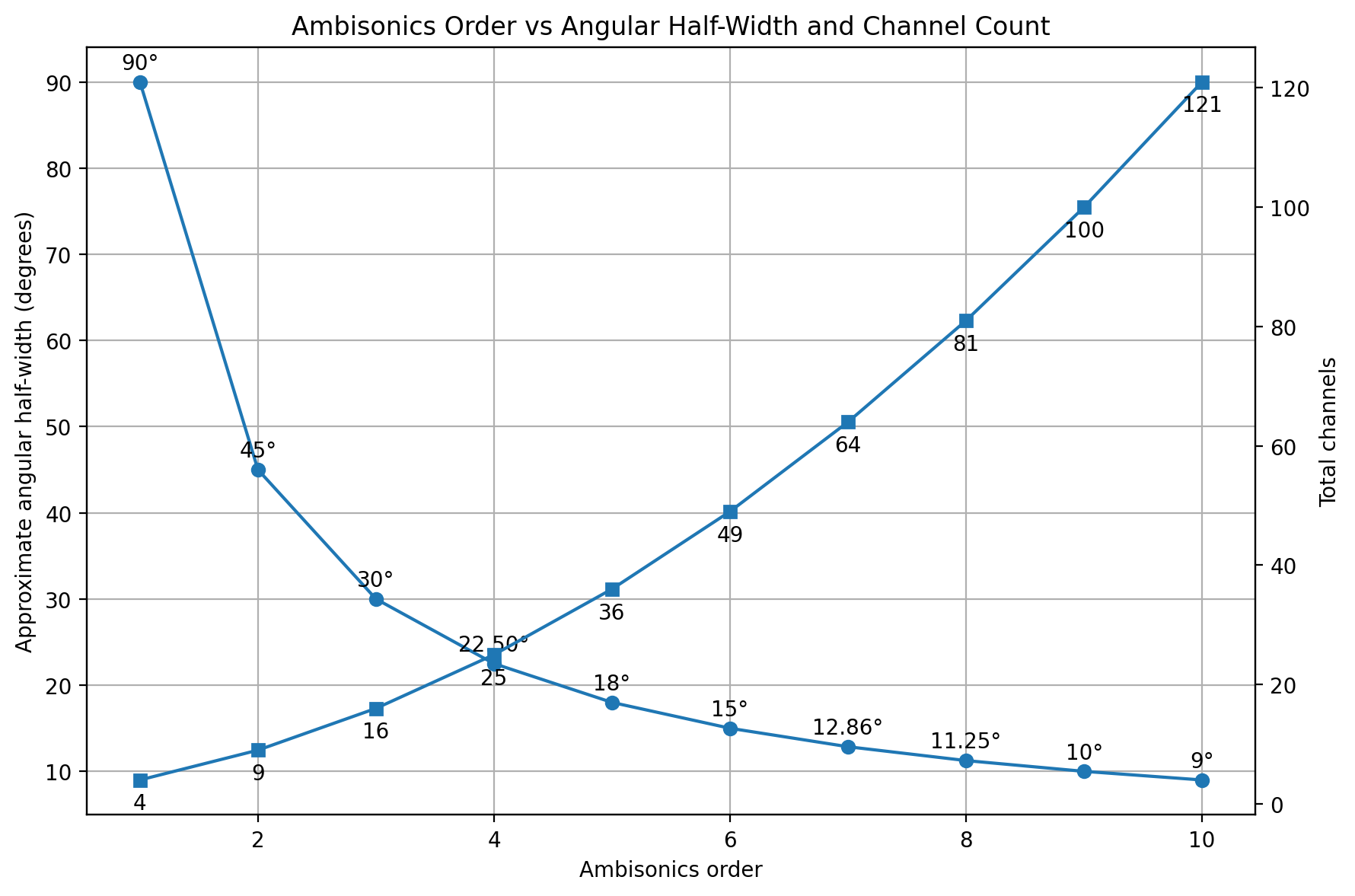
And that comes at a cost!
More channels can mean greater CPU usage, memory consumption, storage requirements and processing complexity.
Of course, this doesn't mean that orders above 7OA are useless. Higher orders can still provide valuable improvements, particularly in specialised research, large loudspeaker arrays and applications requiring exceptionally fine spatial detail.
It's also worth remembering that angular half-width is not the same as beamwidth or actual localisation accuracy. These values describe selected spherical harmonic patterns, rather than the exact performance of an Ambisonics decoder or beamformer.
Nevertheless, the trend illustrates an important principle:
As we move towards increasingly higher Ambisonics orders, the computational requirements grow rapidly, while the improvements in this particular measure of angular detail become progressively smaller.
This makes 7OA a useful practical upper limit in many current Ambisonics workflows — although it's not a mathematical limit of Ambisonics itself.
Ultimately, the ideal Ambisonics order depends on the application, available processing resources and the spatial precision required.
Which Ambisonics Order Should I Use?
Now that we've explored how Higher-Order Ambisonics works, you might be wondering: which order should I actually use?
Well, that depends on whether we're talking about producing audio or playing it back.
Let's make things simple!
1. During Production: Work in 7OA!
Our recommendation is straightforward: produce and mix in Seventh-Order Ambisonics (7OA) whenever possible (or whatever HIGHEST order your DAW allows you to work with).
Why? Because you never know where your audio might end up!
A production might be delivered in stereo today, Dolby Atmos 9.1.6 tomorrow, or an entirely different immersive format in the future.
By producing in 7OA (or HIGHEST order possible), you're working with a high-resolution spatial audio representation containing 64 channels, giving you considerable flexibility when preparing different deliverables.
And remember what we learnt earlier? Every Ambisonics order contains all the spherical harmonics from the previous orders!
This means that if you have a 7OA master, you can easily reduce it to a lower order:
7OA → 5OA: Keep the first 36 channels.
7OA → 3OA: Keep the first 16 channels.
7OA → 2OA: Keep the first 9 channels.
7OA → 1OA: Keep the first 4 channels (W, Y, Z, X).
This process is known as order truncation, and it allows us to create lower-order versions without re-encoding the entire soundfield.
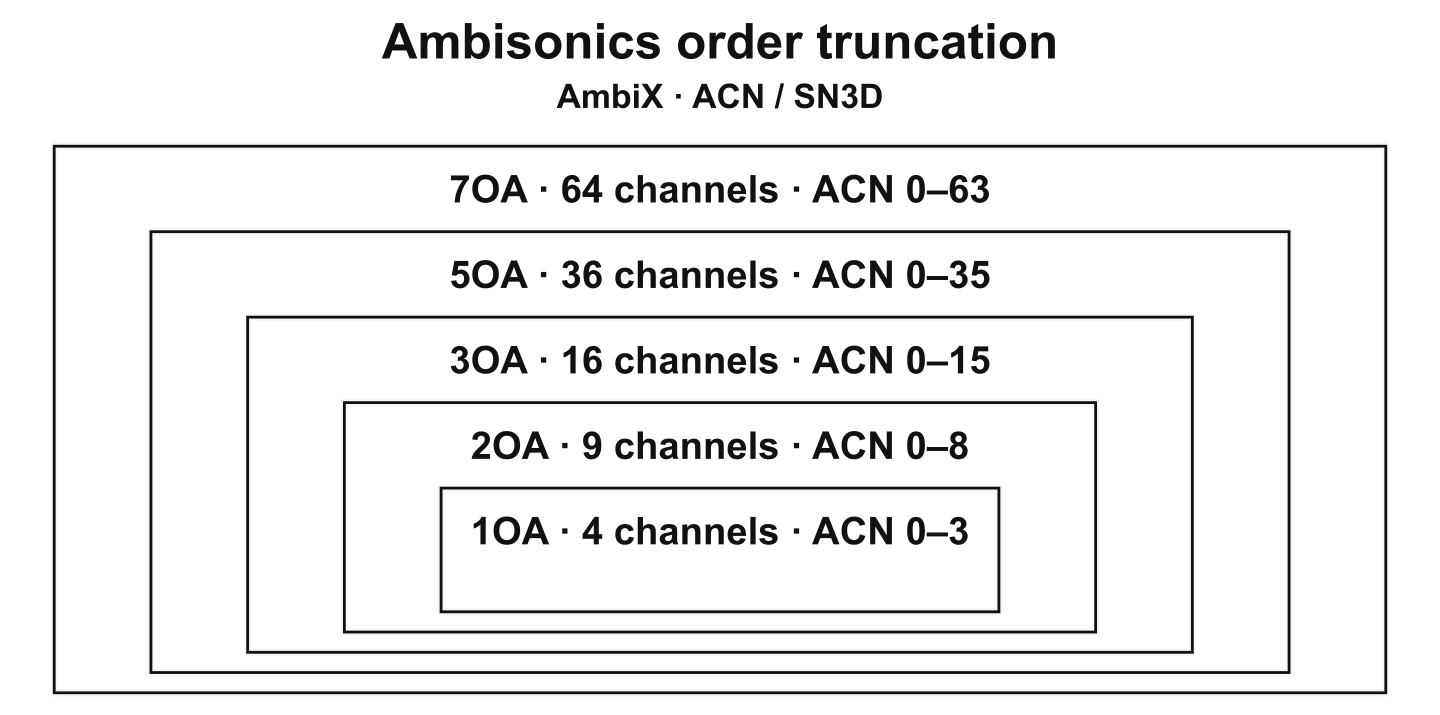
Ambisonics order truncation: a 7OA production contains 64 channels and can be reduced to 5OA (36), 3OA (16), 2OA (9) or 1OA (4) while preserving the retained lower-order components.
However, there's one important detail: working in a 7OA environment doesn't automatically turn a lower-resolution recording into a genuine 7OA recording. The original spatial information still matters.
Nevertheless, when creating and positioning individual sources, working at a higher order from the beginning can preserve greater spatial detail for future deliveries.
Our philosophy? Preserve as much genuine spatial information as possible during production, and decide how to deliver it later!
2. Ambisonics Decoding and Playback: Let Our Decoder Handle It!
When it comes to playback, things become a little more complicated.
The ideal way to decode an Ambisonics signal depends on several factors, including the number of loudspeakers, their positions, the Ambisonics order and the decoding algorithm.
Fortunately, you don't necessarily need to worry about all those calculations yourself!
For example, our ab Advanced Decoder is an Ambisonics decoder designed to simplify immersive audio playback, automatically adapting its decoding to your configured loudspeaker arrangement.
It automatically detects the incoming Ambisonics order and can process lower-order signals through its internal 7OA upscaling stage (when enabled).
It also adapts its decoding to your configured loudspeaker arrangement, supporting layouts ranging from a single loudspeaker to custom arrays of up to 64 speakers.
Of course, upscaling doesn't magically recover every detail missing from a lower-order recording, and even an advanced decoder cannot eliminate the physical limitations of a loudspeaker system.
But it does mean you don't have to manually calculate decoding coefficients or design a separate decoding strategy for every arrangement.
Configure your loudspeakers, feed the decoder your Ambisonics signal, and let it handle the mathematics!
3. How Does Ambisonics Order Affect Loudspeaker Playback?
Still curious? Then let's get a little more technical!
One of the fundamental principles of Ambisonics reproduction is that the number of loudspeakers influences how many spherical harmonic components can be independently reproduced.
Remember our familiar formula?
Channels = (Order + 1)²
In conventional full-sphere soundfield reconstruction, reproducing all the components of a given Ambisonics order generally requires at least as many suitably positioned loudspeakers as there are spherical harmonic components.
For example:
1OA: 4 spherical harmonics — at least 4 appropriately positioned loudspeakers.
2OA: 9 spherical harmonics — at least 9 appropriately positioned loudspeakers.
3OA: 16 spherical harmonics — at least 16 appropriately positioned loudspeakers.
4OA: 25 spherical harmonics — at least 25 appropriately positioned loudspeakers.
However, these numbers describe a necessary channel-count condition for independently reconstructing the full set of three-dimensional harmonics, not a guarantee of accurate reproduction.
Why?
Because the positions of the loudspeakers matter just as much as their number!
Imagine four loudspeakers arranged around you, all at ear level. This is a traditional quadraphonic setup, capable of reproducing sound around you horizontally.
Now imagine arranging those same four loudspeakers in three dimensions, with suitable positions both above and below the horizontal plane.
With the right geometry and decoding, this arrangement can independently reproduce all four components of a First-Order Ambisonics soundfield at the listening position — including vertical directional information!
Same number of loudspeakers, but different spatial capabilities.
This is why the loudspeaker arrangement matters just as much as the number of channels when decoding Ambisonics.
And there's another important distinction.
A system doesn't need to reproduce every spherical harmonic independently to play back an Ambisonics signal!
Modern decoding algorithms can translate higher-order soundfields into loudspeaker signals even when the available speaker count is lower than the number of Ambisonics channels.
Different decoding algorithms use different strategies to translate the available spatial information into loudspeaker signals, balancing factors such as directional accuracy, energy distribution and the physical limitations of the playback system.
For example, it's entirely possible to decode a 7OA recording to stereo, 5.1, 7.1.4 or other playback formats.
However, the resulting spatial accuracy depends on the decoder and loudspeaker arrangement.
This is why there's no universal rule that says a particular playback format must use a particular Ambisonics order.
So, What's the Takeaway?
During production: Work in 7OA whenever practical, particularly when creating spatial scenes from individual sources, and preserve the highest genuine spatial resolution available.
During playback: The most appropriate decoding method depends on your loudspeaker layout, the Ambisonics signal and your reproduction goals.
And if you'd rather concentrate on making music or designing sounds instead of calculating spherical harmonics and decoding matrices, that's exactly why tools such as ab Advanced Decoder exist!
What Are AmbiX, FuMa, ACN and Ambisonics Normalisation?
Before we get into this, let's make one thing clear:
All Audio Brewers plugins use the AmbiX convention (ACN channel ordering + SN3D normalisation).
Why? Because we believe AmbiX is currently one of the simplest and most logical ways to exchange Ambisonics audio between different applications.
More importantly, AmbiX has become the de facto standard for many modern Ambisonics workflows, with widespread adoption across audio plugins, spatial audio tools and immersive production environments.
By following the same convention used by much of the industry, we aim to make our plugins easier to integrate into existing workflows, minimise compatibility issues and simplify the exchange of Ambisonics material between applications.
But what exactly is AmbiX? And why do we also encounter terms such as FuMa, ACN, SN3D and N3D?
Well, here's the thing: Ambisonics describes a soundfield using spherical harmonics, but there are different conventions for how those components are organised and scaled.
Two Ambisonics files can contain information describing the same soundfield, yet use different channel arrangements or normalisation methods.
And if those conventions don't match, the results can be incorrect!
Fortunately, understanding the differences is easier than it might initially seem.
Fortunately, understanding the differences is easier than it might initially seem.
1. What Is Ambisonics Channel Ordering?
Remember how we explained that First-Order Ambisonics (1OA) contains four components?
W, Y, Z and X.
Each represents a different spherical harmonic component of the soundfield.
But here's a question: in which order should we store these four channels?
Should we use W, X, Y, Z? Or W, Y, Z, X?
Mathematically, either arrangement can work, provided the software knows which component each channel represents.
This is called channel ordering, and historically, different Ambisonics conventions have used different arrangements.
Let's look at the two most important ones.
FuMa — Furse-Malham
FuMa is short for Furse-Malham, a convention associated with traditional Ambisonics B-format workflows.
In First-Order Ambisonics, FuMa uses the following channel order:
W, X, Y, Z
Simple enough!
However, when Ambisonics evolved to support higher orders, a more systematic approach to channel numbering became increasingly useful (because how would you label 64 channels with letters?!).
AmbiX — ACN Channel Ordering
AmbiX uses Ambisonic Channel Number (ACN) ordering.
Instead of relying on a sequence of letter names, ACN assigns a unique number to every spherical harmonic component.
And it starts counting at zero!
For First-Order Ambisonics, the ACN sequence is:
ACN 0 → W (Zeroth Order)
ACN 1 → Y (First Order)
ACN 2 → Z (First Order)
ACN 3 → X (First Order)
So, in AmbiX, the four channels are arranged as W, Y, Z, X.
Notice the difference?
AmbiX uses W, Y, Z, X, while FuMa uses W, X, Y, Z.
But the clever part of ACN is how easily it extends to Higher-Order Ambisonics.
The ACN index of a spherical harmonic is calculated as:
ACN = n(n + 1) + m
Where:
n is the spherical harmonic order.
m is the spherical harmonic degree, ranging from −n to +n.
This produces a continuous sequence of channel numbers that works for any Ambisonics order.
For example:
0OA: ACN 0 — 1 channel.
1OA: ACN 0–3 — 4 channels.
2OA: ACN 0–8 — 9 channels.
3OA: ACN 0–15 — 16 channels.
7OA: ACN 0–63 — 64 channels.
Remember how we explained that every Ambisonics order includes all the lower orders?
Well, ACN makes that particularly convenient!
You can reduce a 7OA signal to 3OA simply by retaining channels 0–15 and discarding the higher-order components.
No complicated channel rearrangement required!
And that's one of the reasons ACN is so practical for modern Higher-Order Ambisonics workflows.
| Order | AmbiX (ACN) | FuMa |
|---|---|---|
| 0OA | 0 (W) | W |
| 1OA | 1–3 (Y, Z, X) | X, Y, Z |
| 2OA | 4–8 | R, S, T, U, V |
| 3OA | 9–15 | K, L, M, N, O, P, Q |
| 4OA | 16–24 | Not established |
| 5OA | 25–35 | Not established |
| 6OA | 36–48 | Not established |
| 7OA | 49–63 | Not established |
Each row shows the additional channels introduced at that order. Higher-order signals also contain all lower-order channels.
Notice how AmbiX keeps things consistent and can be used for ANY order (existing or to-exist)
Each new spherical harmonic receives a numerical index following the same ACN formula, regardless of the Ambisonics order.
FuMa, on the other hand, relies on historical letter-based naming conventions that were established only up to Third-Order Ambisonics.
This is one of the major reasons we prefer AmbiX: its channel ordering is predictable, scalable and particularly suitable for modern Higher-Order Ambisonics workflows, including 7OA and beyond!
2. What Is Ambisonics Normalisation?
Now that we know how to organise the channels, there's another important question:
How should we scale their amplitudes?
Remember that spherical harmonics are mathematical functions describing spatial patterns.
Those functions can be expressed using different amplitude scaling conventions without changing their underlying directional patterns.
This is called normalisation.
In practical terms, normalisation determines how strongly each spherical harmonic component is represented numerically.
So, two Ambisonics signals can describe the same soundfield while containing different channel amplitudes, depending on the normalisation convention used.
Let's explore the two most common normalisation conventions in modern Ambisonics.
SN3D — Schmidt Semi-Normalised
SN3D stands for Schmidt Semi-Normalised, extended to three dimensions.
This is the normalisation used by AmbiX.
Under this convention, the real spherical harmonic functions are scaled so their maximum absolute magnitude does not exceed 1.
SN3D provides a consistent way to represent spherical harmonic components across different Ambisonics orders.
N3D — Fully Normalised
N3D stands for Full Three-Dimensional Normalisation.
With N3D, the spherical harmonics are scaled to have equal mean-square magnitude when averaged over all directions on a sphere.
The relationship between SN3D and N3D is straightforward:
N3D = SN3D × √(2n + 1)
Here, n represents the order of each individual spherical harmonic.
For example:
| Harmonic Order | N3D Scaling Relative to SN3D |
|---|---|
| 0OA | ×1 |
| 1OA | ×√3 ≈ 1.732 |
| 2OA | ×√5 ≈ 2.236 |
| 3OA | ×√7 ≈ 2.646 |
| 7OA | ×√15 ≈ 3.873 |
Notice that the scaling increases with the harmonic order.
This doesn't mean N3D contains more spatial information than SN3D.
They're simply two different scaling conventions for representing the same soundfield.
Neither is inherently more spatially accurate, provided the signal is interpreted and processed using the correct convention.
3. How Do AmbiX and FuMa Compare?
Now that we've covered channel ordering and normalisation, we can finally put everything together!
Because here's the important detail:
AmbiX and FuMa differ in both channel ordering and normalisation.
| Feature | AmbiX | FuMa |
|---|---|---|
| Channel ordering | ACN | Furse–Malham |
| First-order channel sequence | W, Y, Z, X | W, X, Y, Z |
| Normalisation | SN3D | FuMa normalisation |
| Higher-order numbering | Systematic ACN sequence | Historical naming and ordering |
| Typical usage | Modern Ambisonics workflows | Traditional and legacy workflows |
For First-Order Ambisonics, FuMa's directional components X, Y and Z have the same scaling as their SN3D equivalents.
However, FuMa's W channel is approximately 3 dB lower than the corresponding AmbiX W channel.
Therefore, converting First-Order FuMa to AmbiX involves two operations:
Reorder the channels from W, X, Y, Z to W, Y, Z, X.
Multiply the W channel by √2, equivalent to approximately +3.01 dB.
That's it!
For higher-order FuMa signals, the conversion also requires the appropriate channel mapping and normalisation factors for those components.
And what about N3D?
Well, ACN/N3D uses exactly the same channel ordering as AmbiX, but with different normalisation.
So converting between ACN/N3D and AmbiX doesn't require rearranging the channels — only applying the appropriate scaling factors.
This is why channel ordering and normalisation must always be considered separately!
4. Which Convention Should I Use?
If you're working with modern Ambisonics software, our recommendation is to use AmbiX (ACN/SN3D) whenever possible.
It provides a predictable channel sequence, scales naturally to Higher-Order Ambisonics, and is widely supported by contemporary spatial audio applications and workflows.
FuMa, on the other hand, remains relevant when working with older recordings, legacy software and traditional B-format material.
N3D is also a valid normalisation convention and appears in various technical and scientific Ambisonics workflows.
Ultimately, the most important rule is simple:
Make sure that the software receiving your Ambisonics signal expects the same channel ordering and normalisation convention as the software sending it!
Otherwise, you may encounter incorrect spatial positioning, amplitude relationships or decoding results.
And remember: simply changing a file's name or metadata doesn't necessarily convert its channel ordering or normalisation.
5. So, What's the Takeaway?
Let's summarise everything we've learnt!
Channel ordering determines the sequence in which Ambisonics components are stored.
ACN is a systematic channel numbering scheme that works across all Ambisonics orders.
SN3D and N3D are two different ways of normalising spherical harmonic components.
AmbiX combines ACN channel ordering with SN3D normalisation.
FuMa uses a different channel ordering and normalisation convention, historically associated with traditional Ambisonics B-format.
Converting between conventions may require channel reordering, normalisation adjustments or both.
At Audio Brewers, we've standardised our plugins around AmbiX (ACN/SN3D) because we believe it provides a consistent and practical foundation for modern Higher-Order Ambisonics production.
And now, whenever you encounter ACN, SN3D, N3D, AmbiX or FuMa, you'll know exactly what they're referring to!